Choosing the correct wiring standard is the most crucial and fundamental step when making network cables. Although most modern devices support automatic reversal, standard consistency still directly impacts project quality and future maintenance.
Currently, the RJ45 interface is the absolute mainstream for cabling, with the standards being T568A and T568B. While they both serve the same purpose: connecting networks, they have a clear division of labor in practical applications:
T568B: This is the default standard for the vast majority of network projects and home renovations in China.
T568A : Originally used for direct connection between two computers. It is now more commonly seen in certain government projects or older telecommunications standards.
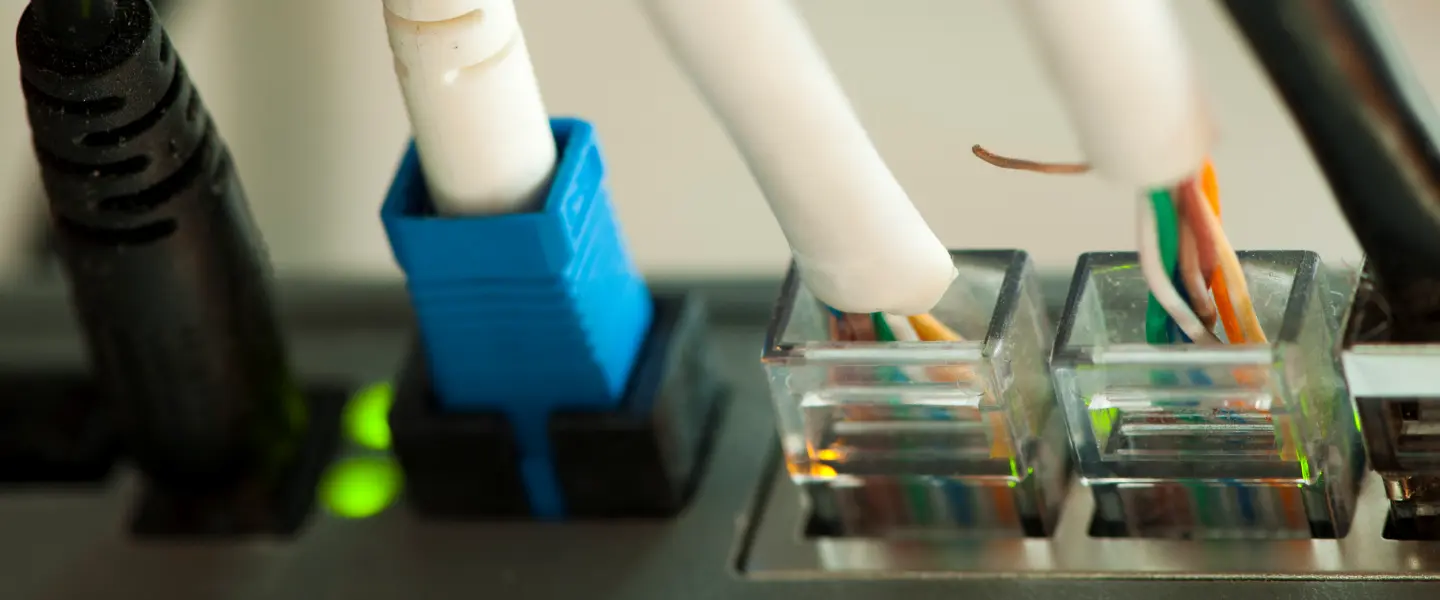
I. Introduction to RJ45 connectors and wiring basics
RJ45 connectors are typically used in twisted-pair cables. Each network cable contains eight wires, divided into different data transmission pairs according to their function. The wires must be arranged in a specific order onto the eight metal contacts of the RJ45 connector. This is done to lay the foundation for stable network communication.
1. T568A Wiring Sequence
When holding the plug with the plastic tab facing down and the gold metal contacts facing up. The sequence from left to right is:White-Green, Green, White-Orange, Blue, White-Blue, Orange, White-Brown, Brown.
2. T568B Wiring Sequence
Using the same orientation, the sequence from left to right is:, White-Orange, Orange, White-Green, Blue, White-Blue, Green, White-Brown, Brown.
The fundamental distinction between these two standards is the swapping of the orange and green pairs. Specifically, pins orange in B, green in A and pins green in B, orange in A are reversed. The blue and brown pairs remain in the identical positions for both standards.
II. Application Scenarios of T568A and T568B
1. T568A Applications
T568A is commonly used in government or public building network cabling standards.
It supports backward compatibility with older telephone lines and some residential cabling standards.
T568A is often used by default in applications requiring consistent straight-through network cables at both ends.
2. T568B Applications
T568B is more commonly used in commercial offices and enterprise networks.
It corresponds to the older AT&T 258A system standard, making it easily compatible with legacy cabling. Many network equipment manufacturers provide T568B pre-installed network cables by default.
3. Straight-through Cables vs. Crossover Cables
Straight-through Cables: Both ends use the same wiring sequence, used for connecting a computer to a switch or router.
Crossover Cables: Both ends use different wiring sequences, used for direct connection between two computers. Modern switches mostly support automatic MDI/MDIX functionality, reducing the need for crossover cables.
III. The Significance of Wiring Sequence Selection
Choosing between T568A and T568B is not just a matter of "aesthetics". But also involves network compatibility and standardized management:
Compatibility: If your network already has a batch of network cables using a certain standard. It's best to keep new lines consistent to avoid connection errors.
Maintenance and Management: A unified wiring sequence facilitates future maintenance and troubleshooting, avoiding network outages caused by inconsistent wiring sequences.
Standard Compliance: In government or enterprise projects, following standards ensures compliance with acceptance and construction specifications.
In short, the core of wiring sequence selection is consistency, not performance differences. Both types offer essentially the same transmission speed and stability.
IV. Conclusion
RJ45 T568A and T568B are simply two standards used in network cabling. They are essentially the same in function: connecting networks. However, they differ in their emphasis on compatibility, manageability, and standards compliance.
In modern networks, regardless of which standard is chosen. Maintaining consistency throughout the network is crucial. By understanding these two wiring sequences and their significance. Network cabling personnel can complete cabling work more efficiently and systematically.
